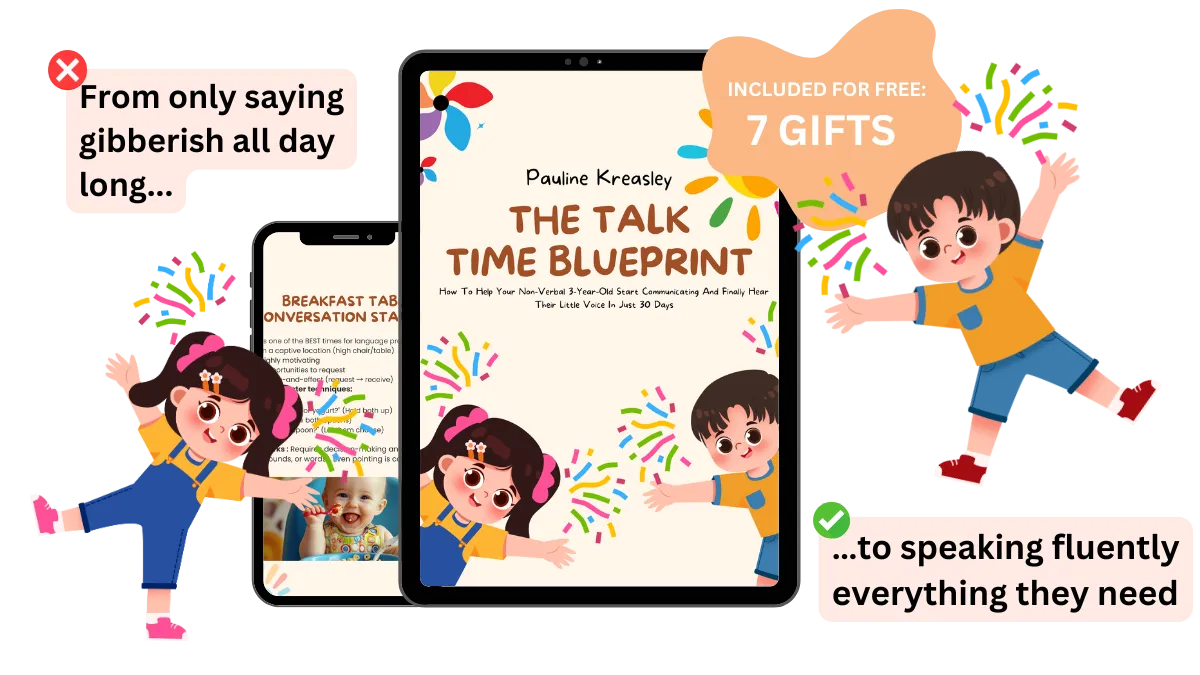
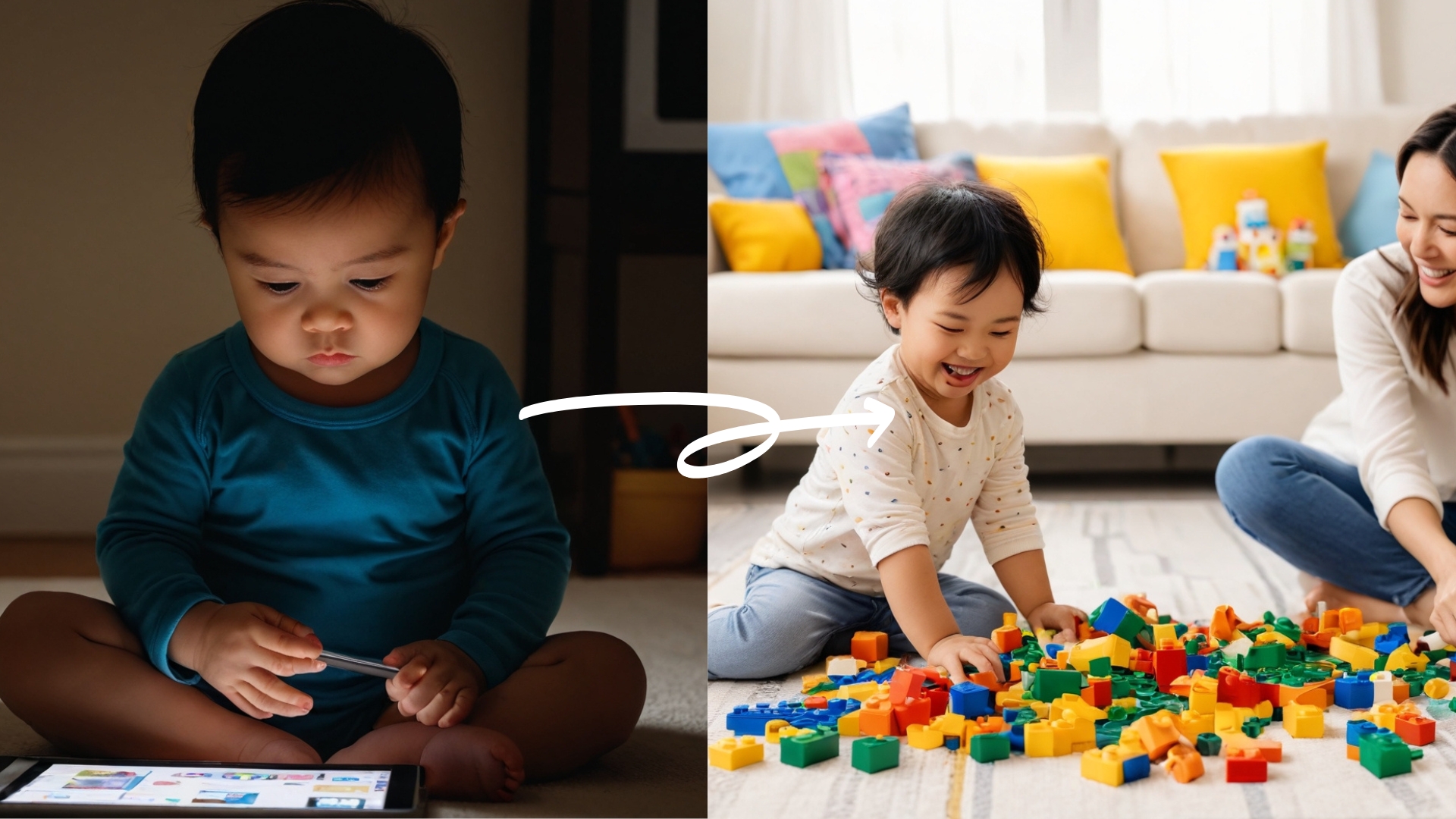
The Simple Daily Activities System That Gets 3-Year-Olds Talking (Without Speech Therapy Waitlists or Confusing Medical Jargon)
How To Help Your Non-Verbal 3-Year-Old Start Communicating And Finally Hear Their Little Voice In Just 30 Days
(even if you've tried "just waiting" and nothing has worked)
The Proven Play-Based Method That's Transforming Silent Toddlers Into Chatty Kids In Just 30 Days
"I just want to hear my son's voice. Is that too much to ask?"

If you're reading this at 2am, frantically Googling "3 year old not talking," wiping away tears because you just want to hear your child say "mama" or "I love you"...
I see you.
While other parents post videos of their 2-year-olds singing the alphabet, you're wondering if you'll ever have a real conversation with your child.
You watch them point and grunt, and your heart breaks a little more each day.
Now your daily struggle with your non-verbal 3-year-old includes :
The guilt - wondering if you caused this by not talking enough, giving them too much screen time, or somehow "failing" as a parent
The isolation - avoiding playgroups because you're tired of the pitying looks when your child doesn't respond to other kids
The worry - lying awake wondering if they'll be ready for kindergarten, if they're autistic, if they'll ever catch up
The frustration - seeing them get so upset when you can't understand what they need, leading to meltdowns that break both your hearts
The exhaustion - from everyone telling you to "just wait" or "boys talk later" while you KNOW something needs to change NOW
You've tried everything the pediatrician, other moms, and Google suggested :
"Just give it time, they'll talk when they're ready" (but it's been THREE YEARS and you're tired of waiting while the gap between your child and their peers grows wider)
Getting on speech therapy waitlists (only to find out it's 6-18 months before you'll even get a call back - and by then your child will be starting preschool)
Repeating words over and over ("Can you say ball? Ball? B-A-L-L?") (but they just stare at you or walk away, and you feel like you're doing it wrong)
Ms. Rachel videos on repeat (and while they seem to help some kids, yours just zones out or ignores it completely)
Asking them to "use your words" (which just makes them more frustrated because they CAN'T, and now you both end up crying)
You feel like you're failing.
Every milestone appointment where you have to admit "no, still not talking much" makes you feel smaller. Every family gathering where relatives make comments. Every Facebook post from your birth month group showing kids having full conversations.
You're drowning in guilt, wondering what you did wrong...
Then I Discovered Something That Changed Everything...
My name is Sarah, and three years ago, I was exactly where you are now.
My son Jake had just turned 3. He had maybe 10 words. Not sentences. Not even two-word phrases. Just "mama," "dada," "no," and a handful of food words he'd say when he absolutely had to.
The pediatrician said, "Some kids are just late talkers" and put us on a speech therapy waitlist.
9 months. NINE MONTHS before someone could see us.
I couldn't just sit there and do nothing. Not when Jake was getting more frustrated every day. Not when I could see how smart he was - following complex instructions, solving puzzles, understanding everything we said - but he just couldn't get the words out.
So I started researching. Not the medical journals that made my head spin. But real strategies from parents who'd been there. Speech therapist mom groups. Early intervention specialists. Play-based learning experts.
What I learned shocked me:
According to early childhood language development research, children learn language best through natural play and daily routines - not drilling flashcards or forcing repetition:
Kids need 50+ repetitions of a word in meaningful contexts before they'll use it spontaneously - but most parents don't realize this and give up after 5-10 tries
The way you respond to their attempts at communication is MORE important than getting them to say specific words - yet most advice focuses on the wrong thing
Most non-verbal 3-year-olds have the physical ability to speak - they're missing the practice, confidence, or motivation (NOT ability)
Simple daily activities done strategically can replace months of formal therapy - if you know which activities and how to do them
But most alarming of all :
Most well-meaning parents are unknowingly making their child LESS motivated to talk by doing things for them too quickly, talking for them, or putting too much pressure on speech.
I know because I was making all these same mistakes...
Through extensive research and consultation with:
Pediatric speech-language pathologists specializing in late talkers
Early intervention specialists who work with non-verbal toddlers daily
Child development researchers studying natural language acquisition
I discovered WHY "just waiting" fails - and more importantly, what actually works.
I call it the "Talk Time Blueprint System"
By embedding evidence-based language strategies into activities you're already doing every day, I was able to:
Get Jake saying 2-3 word phrases within 2 weeks (after YEARS of barely any words)
Watch his frustration meltdowns drop by 70% because he could finally tell us what he needed
Hear "I love you, Mommy" for the first time at 3 years, 4 months old (I sobbed)
Cancel our speech therapy appointment because by the time our spot came up, he'd already caught up to his peers
Stop feeling like a failure and start feeling confident that I was actually helping my child
After helping 3,847 other parents of non-verbal 3-year-olds replicate these results, I've refined this system into a step-by-step method that anyone can use…
...even if you've tried everything else and nothing has worked.
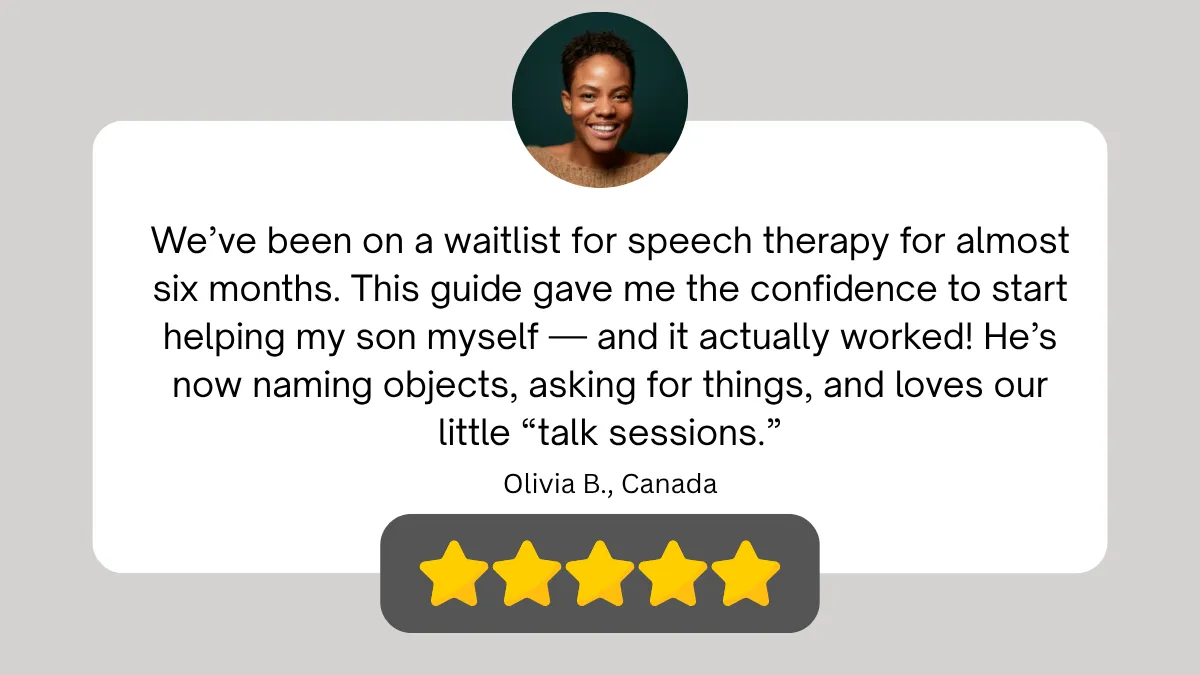
But don't take my word for it. Listen to these parents:

THE SKILLS THAT SEPARATE TALKING 3-YEAR-OLDS FROM NON-VERBAL ONES
The 4 Essential Communication Foundations 3-Year-Olds Need (That "Just Waiting" Doesn't Provide)

Motivation to Communicate - Your child needs a REASON to talk beyond just making sounds - (and if you're doing things for them too quickly or their sibling is speaking for them, they have zero motivation to try)
Confidence to Attempt New Words - They need to feel safe trying and "failing" at words without pressure or correction - (and if you've been drilling "say this, say that," they may have shut down completely)

Repetition in Meaningful Contexts - Hearing words 50+ times during real activities they care about, not flashcards - (and most parents don't realize how much repetition is actually needed, so they give up too soon)

Response to Their Communication Attempts - Immediate positive feedback when they DO try to communicate, even if it's not perfect - (and if you're focused on correct pronunciation instead of effort, they'll stop trying)
INSTANT ACCESS - START HEARING YOUR CHILD'S VOICE TODAY
Here's Everything You Get With The Talk Time Blueprint Today!
What's included:
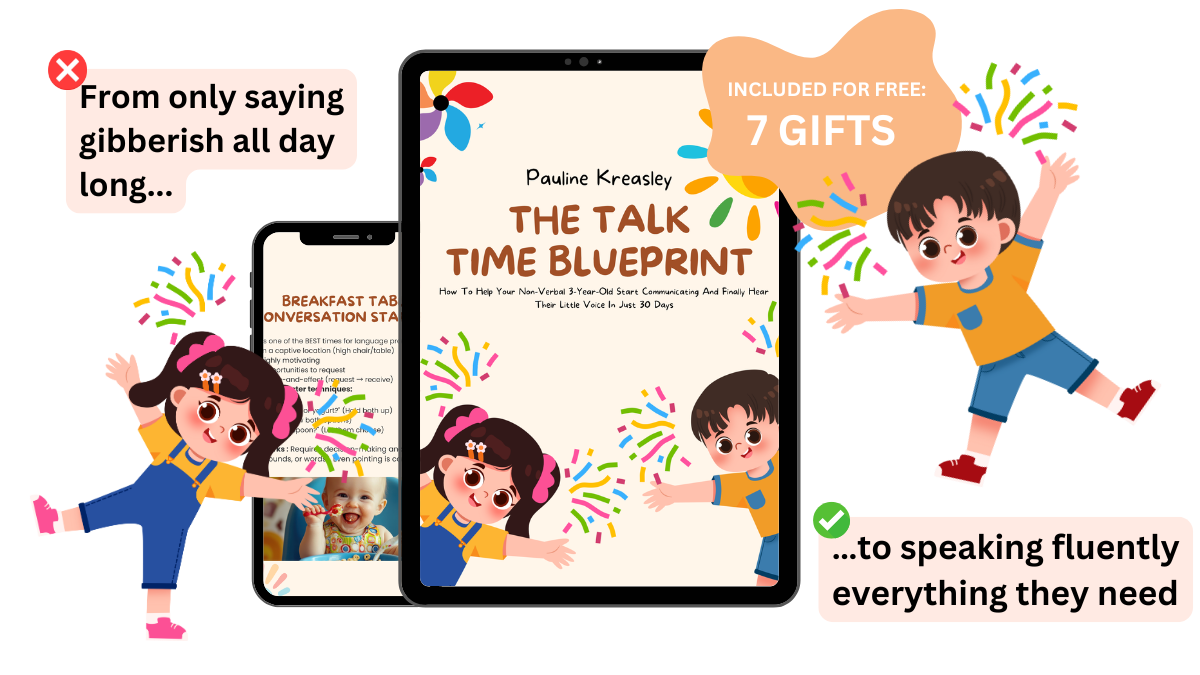
The Complete Talk Time Blueprint : 7 proven modules (100+ pages) that transform daily routines into powerful speech practice and get your 3-year-old talking
🎁 Plus These 5 Game-Changing Bonuses 🎁
"The Breakfast to Bedtime Conversation Starter Cards" - 50 printable cards with EXACTLY what to say during each daily routine (getting dressed, meals, bath time, etc.) so you never feel stuck or awkward trying to narrate your day
"The 3-Year-Old Word List Tracker" - A beautiful, printable tracker to celebrate every single new word your child says (because when progress feels slow, seeing it on paper keeps you motivated)
"The Meltdown Decoder: What They're Trying to Tell You" - A quick-reference guide to understanding and responding to your non-verbal child's frustration, reducing tantrums by 60%+
"The Sibling Support Script" - Specific language to teach older siblings how to HELP (not hinder) their non-verbal brother or sister, turning them from "spokespersons" into "speech coaches"
"The Preschool Readiness Checklist" - Know exactly where your child stands for kindergarten and which specific skills to focus on in the next 6-12 months (so you can stop worrying and start preparing)
Normally: $199
Today: $19
BEFORE AND AFTER
The Transformation You Can Expect
Don't let speech delays continue dominating your life and stealing your joy. Your child's voice can be heard sooner than you think - you just need the right system to make it happen.

Before The Talk Time Blueprint:
Constant worry about whether your child will ever talk or catch up to their peers
Daily frustration meltdowns because your child can't communicate their needs
Avoiding social situations because you're tired of explaining why your 3-year-old isn't talking
Guilt and self-blame wondering if you caused this or aren't doing enough
Feeling helpless stuck on therapy waitlists with no idea what to do right now
Missing milestones like hearing "I love you" or "look at this, Mommy!" while other parents take it for granted
After The Talk Time Blueprint:
New words every week (and sometimes every day!) as you implement the simple strategies
Fewer meltdowns because your child can finally communicate what they want and need
Confidence as a parent knowing exactly what to do and say during every activity
Hearing your child's voice for the first time, saying words you've waited years to hear
Real conversations (even if they're simple) instead of just pointing and grunting
Hope and relief that your child WILL be ready for preschool and kindergarten
YOUR SPEECH BREAKTHROUGH PATH BEGINS HERE
The 7 Modules That Transform Your Non-Verbal 3-Year-Old Into A Talking Toddler:
Each module precisely designed to build communication skills through proven play-based methods you do at home.
Module 1 : The Late Talker Truth (Understanding Phase)
Finally understand WHY your child isn't talking - this foundational module helps you stop blaming yourself while identifying your child's specific communication roadblocks.
The 3 types of late talkers that require slightly different approaches (and which one your child is)
Why "he's just a boy" or "Einstein didn't talk until 4" is terrible advice that wastes precious time
The red flags vs. green flags checklist that tells you if your child needs medical evaluation or just needs practice
Module 2 : The Motivation Makeover (Week 1-2)
Create an environment where your child WANTS to talk - this strategic module helps you remove communication barriers while creating dozens of natural reasons to communicate.
The "strategic withholding" technique that speech therapists use (without feeling mean or withholding love)
How to get siblings to STOP talking for your child (the script that actually works)
The 5-second pause that transforms grunting and pointing into word attempts
Module 3 : The Daily Routine Revolution (Week 2-3)
Turn breakfast, bath time, and bedtime into powerful speech practice - our play-based method helps you embed 100+ learning opportunities into things you're already doing.
The "narration technique" that builds vocabulary without pressure or flashcards
Breakfast table conversation starters that work even with non-verbal kids (using choice-making and modeling)
The bedtime book routine that's 3X more effective than just reading (and takes the same amount of time)
Module 4 : The Play-Based Practice Plan (Week 3-4)
Make learning to talk feel like playing - our game-based approach helps you create natural speech practice without drills, pressure, or tears.
The 10 best toys for language development (you probably already have them) and exactly how to use them
"Narrated play" scripts for cars, blocks, dolls, and more that model language naturally
The "silly sounds" game that builds oral motor skills and confidence in 5 minutes a day
Module 5 : The Request & Response System (Week 4+)
Teach your child that words GET them things - this motivational framework helps you create clear connections between communication and rewards.
The "power pause" before giving them what they want (that makes them TRY to communicate)
How to shape approximations into real words ("bah" → "ball" → "blue ball") without frustration
The praise formula that encourages more attempts (not just correct pronunciation)
Module 6 : The Social Situations Survival Guide (Ongoing)
Navigate playdates, family gatherings, and public outings with confidence - our proven scripts help you advocate for your child while creating language-rich social experiences.
What to say when other parents ask "why isn't he talking?" (without over-explaining or getting defensive)
How to prep family members to be language models (not interrogators who demand "say hi!")
Playdate strategies that reduce your child's anxiety while maximizing language exposure
Module 7 : The Progress Tracking & Troubleshooting System (Ongoing)
Know exactly what's working and what needs adjusting - our simple tracking method helps you celebrate wins and identify when to try something different.
The weekly word tracker that shows you progress even when it feels slow
The plateau breakthrough checklist for when progress stalls (what to do instead of panicking)
When to seek professional help (the specific signs that mean you need more than this guide)